
A curated on-ground experience for global teams building AI product innovation across Sub-Saharan Africa (SSA)
By the YUX Design Team
In March 2026, our team facilitated a comprehensive research immersion for a Big Tech in Nairobi, Kenya.
What is product immersion? Product Immersion is a structured, multi-day experience that places product teams inside the markets they are building for.
These immersions are critical because they move global product and marketing leaders away from relying solely on aggregated data or assumptions, directly connecting them with the African market. When it comes to building for AI, firsthand experience and primary research are the most powerful tools to learn, understand and showcase the unique opportunities for users in SSA
The Nairobi Edition
For our client, the goal of the Nairobi edition was to run across residential neighbourhoods, retail, and public spaces. The profiles we talked to were youth aged 18–35 who live, work, or study in Nairobi, including students, business owners, and content creators.
With global team members (product managers, software engineers, and researchers), we explored their perceptions, attitudes, and behaviours around technology and AI in their daily lives. To achieve this, we combined quantitative grounding with qualitative breadth, workshops, and our newest innovative methodology: Live LLM Testing (RLHF) and Interactions.
Methodology Deep Dive
1. User Research Deep Dive
We combined large-scale data, one-on-one conversations and focus groups to challenge existing assumptions, uncover insights, and identify opportunities.
- Quantitative Baseline Study via LOOKA: We conducted a study with participants (n=300) in Nairobi to establish foundational behaviours, use cases, and pain points across three research tracks: AI, Information Seeking, and Content Creation/Consumption.
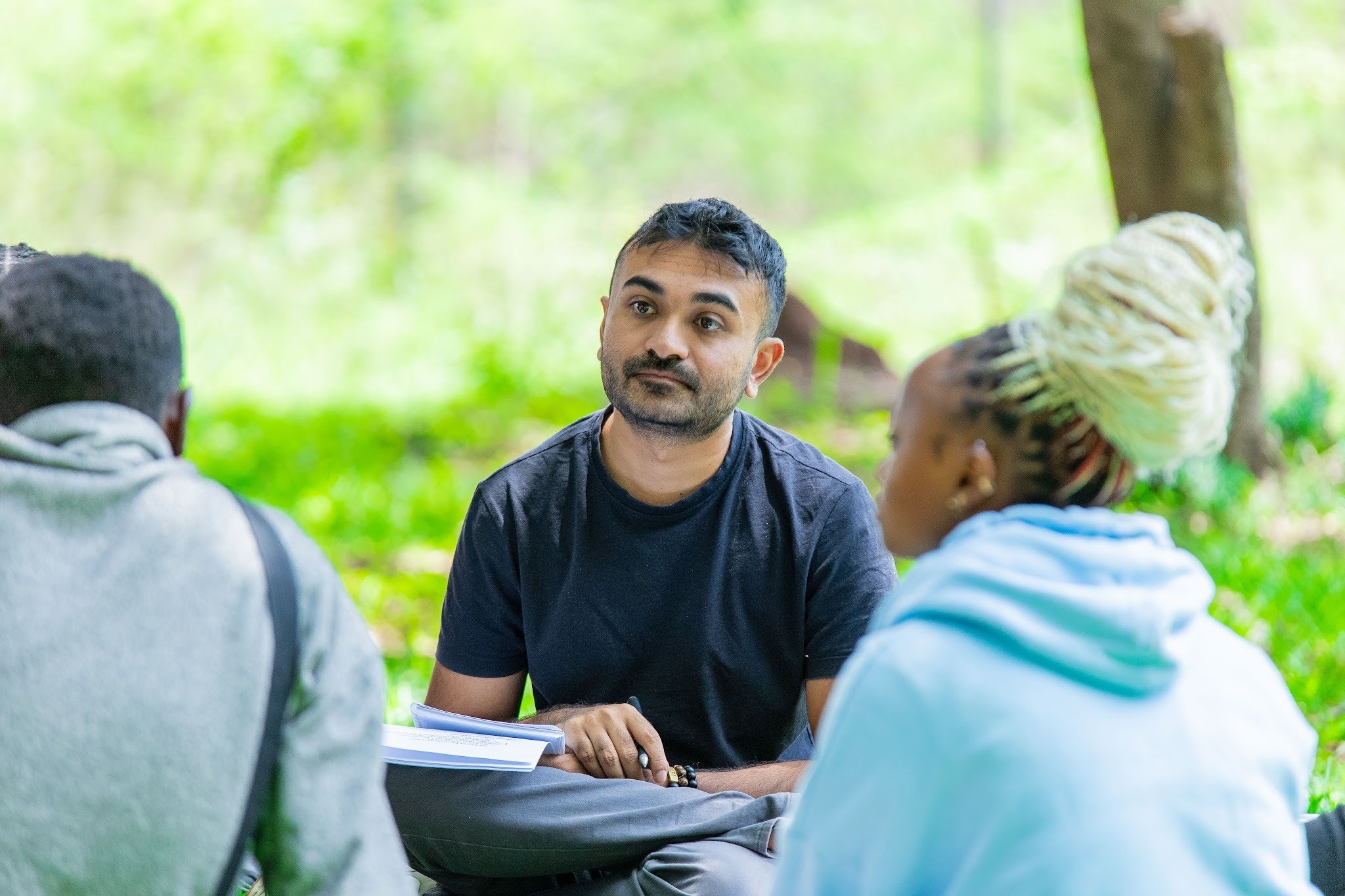
- Field & Market Visits: Following the quantitative work, we moved into the field, starting with 20–30-minute conversations in public places and retail locations to observe real-life product use.
Focus Groups: We held two-hour guided discussions using creativity exercises to test digital prototypes and unlock richer conversations. - Home Visits: We moved on to one-on-one interviews in participants' homes in residential neighbourhoods, shifting the focus from what users say they do to what they actually do in their natural environments.
- Industry Roundtable & Panel: We curated intimate conversations with founders, community builders, and ecosystem players who are already solving problems in the market.
2. Live LLM Testing (RLHF): Diary Study
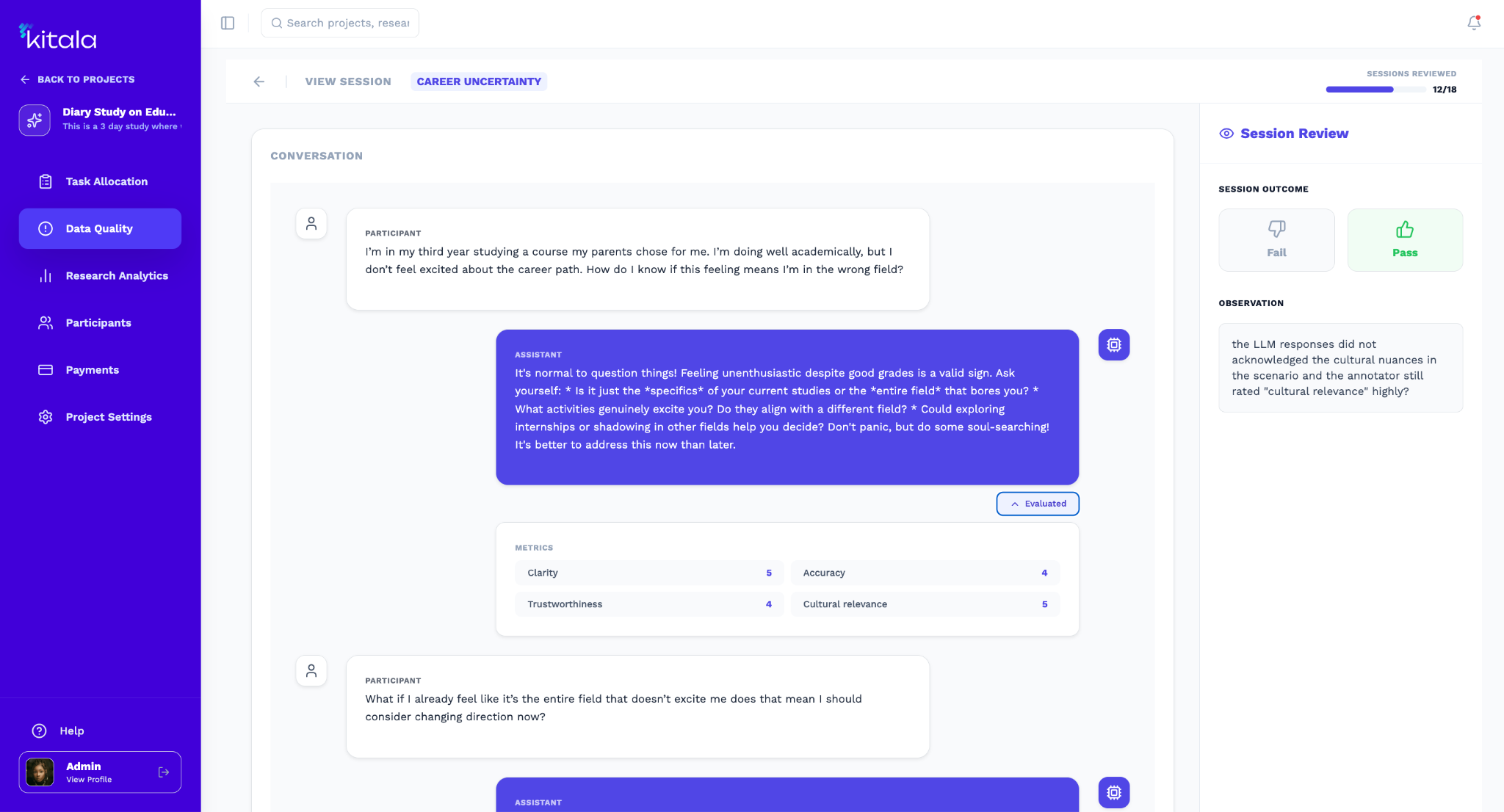
To observe AI use as it unfolded over time, we designed a short diary study using Kitala.ai to examine the lived experience of students and recent graduates in Kenya.
- Selected Profiles: For three days, participants (n=20) were split into two groups: 14 AI Power Users (who use AI tools to work faster, create content, learn more efficiently) and 6 AI Regular Users (who use AI for simple tasks like writing messages or getting quick answers).
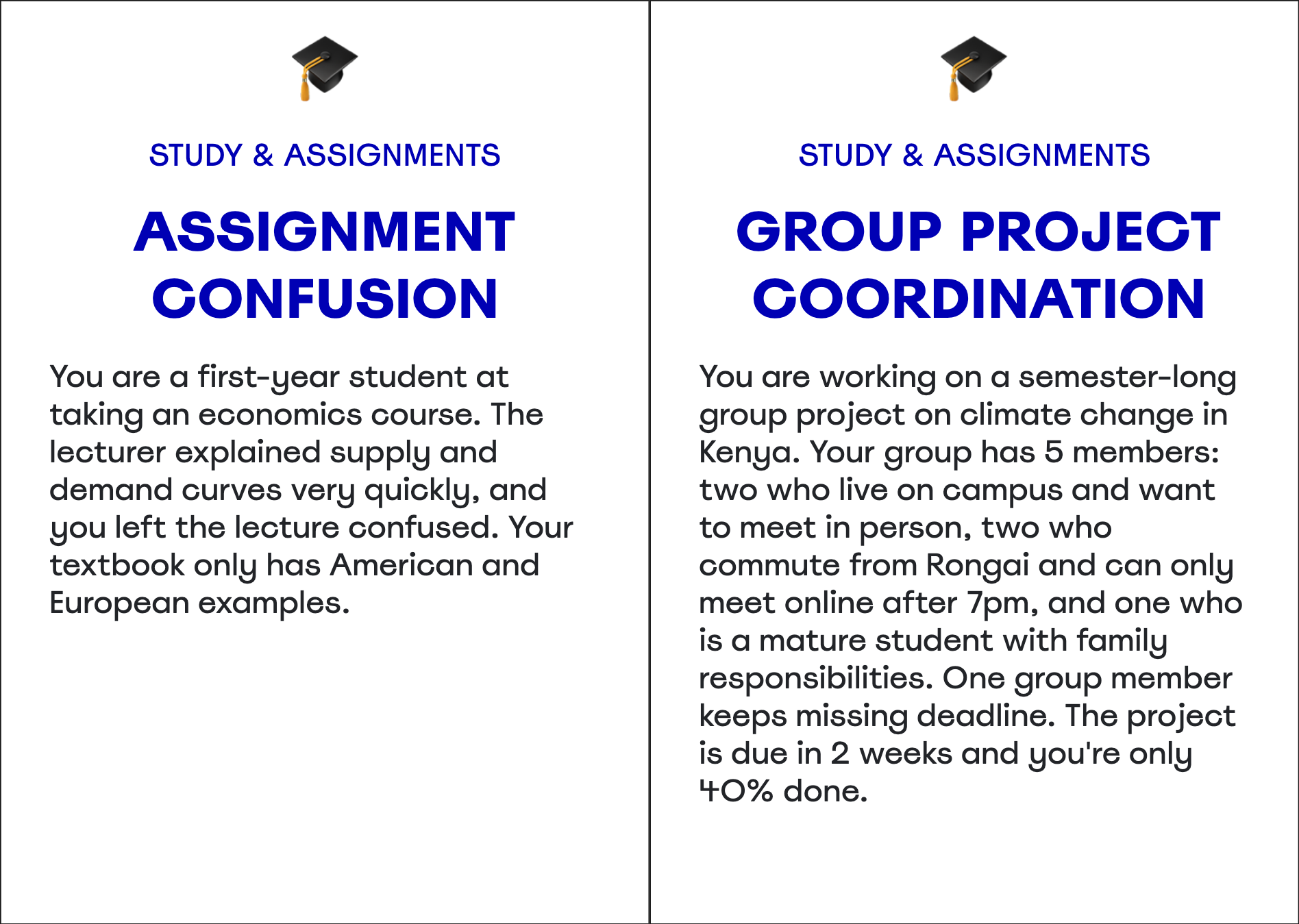
- Study Design: Participants worked through eight different scenarios covering moments that regularly shape their lives: completing coursework, preparing for exams, searching for jobs, planning careers, and engaging in other education-related tasks.
- Ratings & Evaluation: This resulted in 300 Human-Based Evals (20 people x 3 scenarios x 5 turns) as participants evaluated the AI-generated responses based on clarity, tone, contextual relevance, and how well it spoke to the realities of Kenyan students and recent graduates.
3. Live LLM Interactions: Cultural Teaming
During the immersion week, we conducted in-person Cultural Teaming sessions to examine their interactions with and evaluations of AI chatbots. Cultural Teaming, adapted from Chiu et al. (2024), integrates scenario-based testing, structured reflection, and creative role-play to surface cultural, linguistic, and contextual dimensions.
- Selected profiles: University students (n=6), came in for the workshop who engaged with AI chatbots.
- Study Design: Together with the immersion attendees, participants were guided through real-world scenarios ranging from a “Day in the Life as a Student” to “Looking at the Future.” Some tested how fast the AI could answer; others pushed its limits with tricky prompts. These activities were designed to break the model and surface complex constraints, including:
- Linguistic practices (Sheng-speaking, code-switching, very short/lazy typing with multiple typos).
- Emotional states (panic, fear, embarrassment, urgency).
- The influence of user belief systems (such as conspiracy-mindedness or emphasis on authenticity/originality of thoughts or ideas). - Ratings and Evaluations: After the interactions, discussions were held to evaluate the chatbot's responses based on criteria including cultural appropriateness, linguistic clarity, trustworthiness, and practical relevance.
4. Debrief & Synthesis Workshop
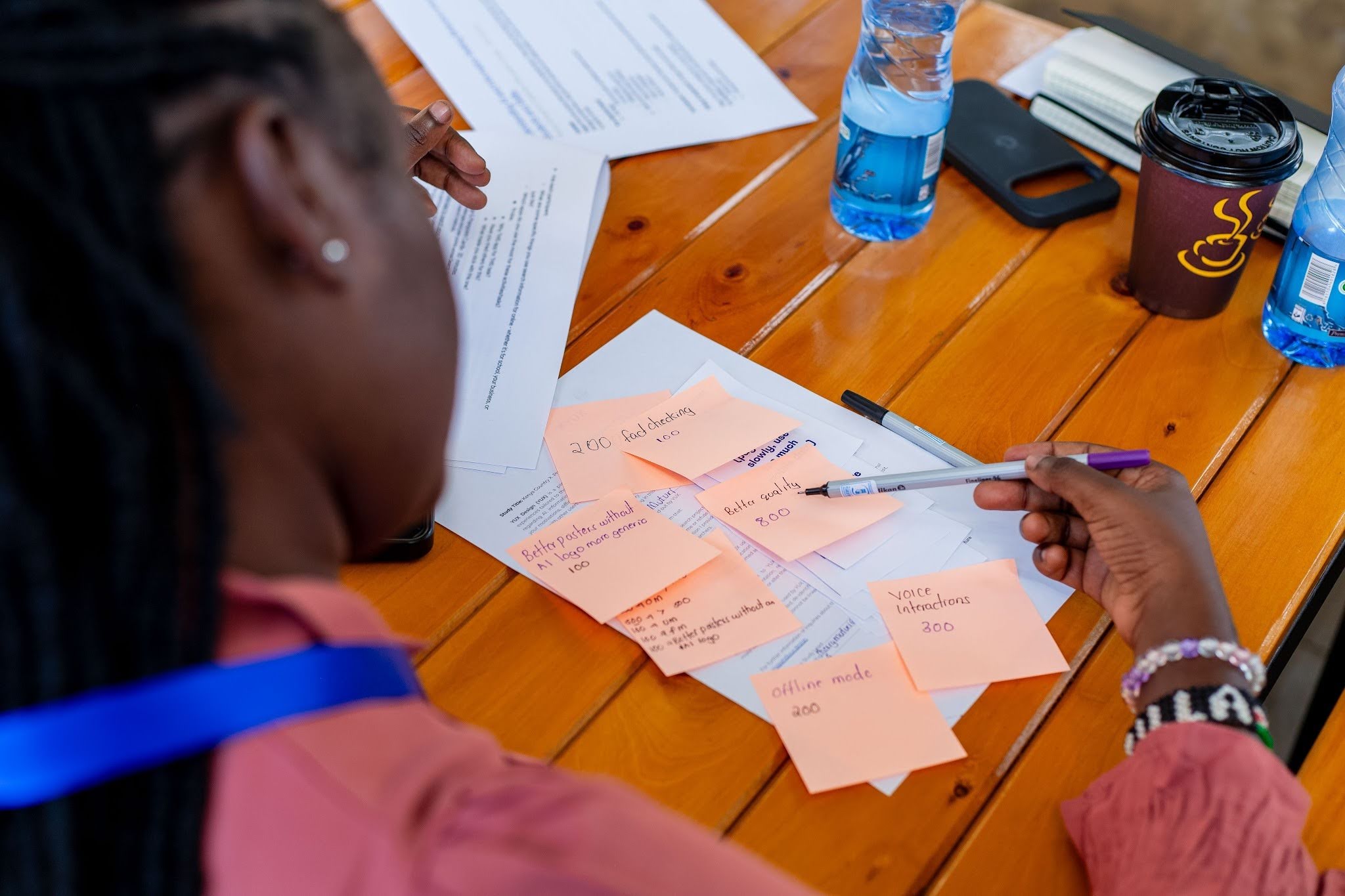
The immersion closed with a half-day synthesis workshop. Researchers and product teams worked through the findings together, translating what they had seen into specific, ranked opportunities.
Core Insights and Reflections
With the combination of these innovative methodologies- quantitative baselines, the market/field visits, home visits, the focus groups, the diary study, and the cultural teaming sessions- several critical insights stood out for developing localised AI products such as
The Quiet Failure of Cultural Relevance
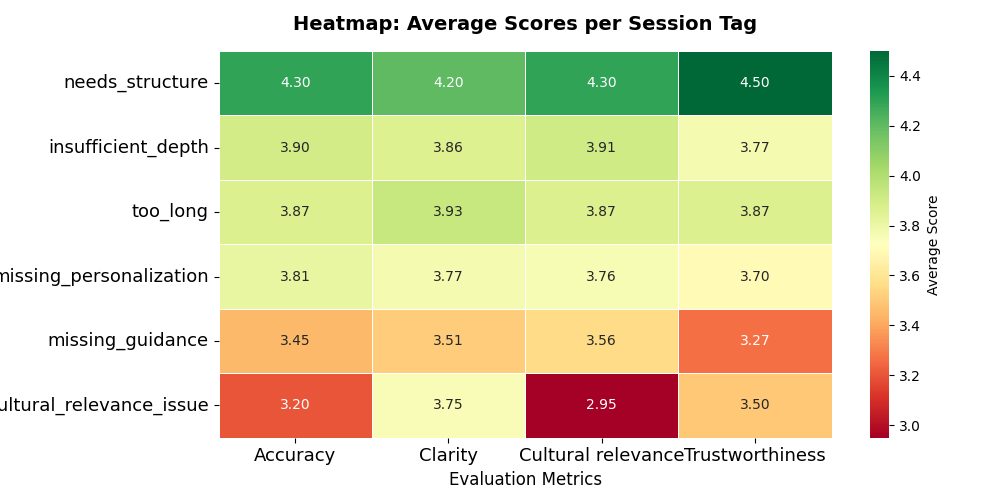
The Diary Study revealed a pattern: cultural relevance was the lowest-scoring metric, yet students rarely called it out directly as the reason for dissatisfaction. The friction was real, responses felt foreign, Sheng references felt off, but it didn't translate into low scores.
When AI Lacks Empathy: Breaking Down in Emotional Scenarios
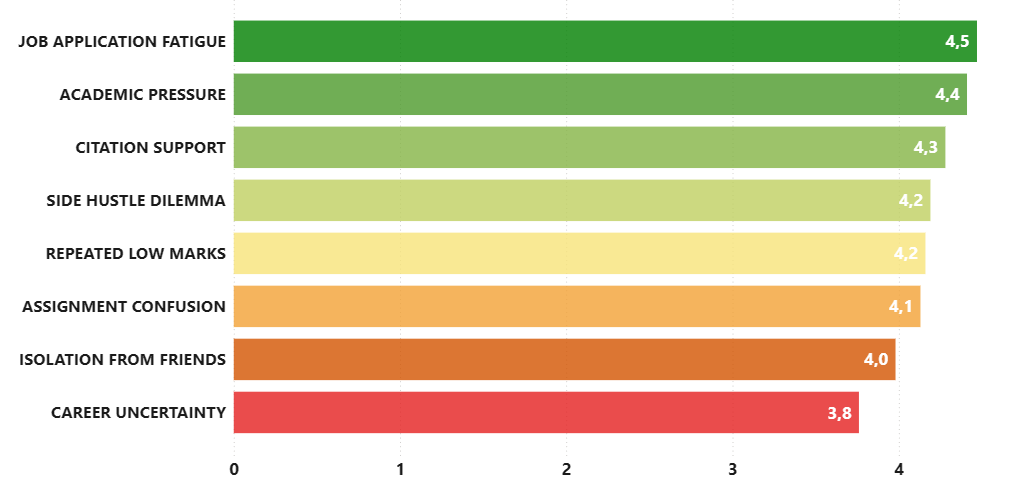
The Diary Study revealed that when emotional stakes were high, the models defaulted to generic, textbook-style advice. Scenarios like 'Career Uncertainty' and 'Isolation from Friends' received the lowest scores because users felt the responses lacked real empathy or local grounding.
The Authenticity Gap: Language and Social Dynamics
From the cultural teaming workshop, we found that students consistently found chatbots useful and friendly, valuing their encouraging tone and problem-solving flexibility. However, they note that AI often struggles with the unique language and social dynamics of their daily lives. Specifically, a lack of deep local context regarding Kenyan university pressures often results in translations that feel inauthentic, highlighting a gap in the technology's grasp of the students' specific cultural environment.
As one participant noted: "The chatbot is very useful and friendly. It solves a lot of problems, although not all, because somehow the local language translation is not that authentic."
Conclusion
The Nairobi Immersion successfully integrated deep qualitative user research with Live LLM Testing methodologies: the Diary Study and Cultural Teaming. This powerful combination generated actionable insights and opportunities and shifted the global team's understanding of Sub-Saharan Africa’s potential, positioning them to build truly authentic, impactful, and locally grounded AI products for the continent.
This immersion was a collaborative effort between YUX Design and a Big Tech technology and AI company in Nairobi in March 2026. Participant and client details have been anonymised.